 Classroom Noise Monitor
Classroom noise management strategies that actually worked in my room (and the ones that flopped)
 Suprity Acharyya
There was a term when my main classroom management tool was my own voice, and my voice was losing. The worst window was right after lunch. Twenty-seven students would come in at conversation volume, and within ninety seconds the room would hit rolling boil, because every child spoke just a little louder than the child next to them so they could be heard. By Thursday of a bad week I was rationing my own talking to save what was left of my throat.
I thought that was just teaching. It isn't. Teachers develop voice disorders at roughly double the rate of everyone else, around 12% versus 6% in the general population, and voice problems cost the average teacher about two sick days a year. My lost voice wasn't bad luck. It was a system failure, and the system was "Suprity shushes people."
So I stopped collecting tips and started treating noise as a system problem. Tips are what you do in the moment. A system is why the moment stops happening. Everything in this article has run in my actual classroom. I'll tell you what stuck, what flopped, and what order to try things in.
Why classrooms get loud (and why "be quiet" doesn't work)
Rooms don't get loud because children are bad. They get loud because of a ratchet. To be heard over the ambient noise, each student speaks slightly above it, which raises the ambient noise, which makes the next speaker louder still. Nobody in the room decided to shout. The room decided for them. Once I explained this to my class, something surprising happened: they started catching it. A ten-year-old announcing "we're ratcheting" is a better intervention than anything I ever did with my arms crossed.
The scale of the problem is bigger than it feels from the front of the room. The US classroom acoustics standard says background noise should stay under 35 decibels, roughly the level of a quiet library whisper. For reference, normal speech sits near 60 dB. When researchers ran more than 250 sound checks in a real high school, the quietest reading they recorded was 55 dB and the average was 63.7. Not one measurement met the standard. Not one.
This matters because noise isn't just annoying, it's expensive. A study of 220 classrooms across 40 schools found that higher background noise levels correlated with lower math scores, even after controlling for socioeconomic factors. The most vivid evidence is older: in 1975, Bronzaft and McCarthy compared classes on opposite sides of a New York school that sat next to elevated train tracks. By sixth grade, the students on the noisy side were about a year behind in reading. After the city treated the noise, a follow-up study found the gap had disappeared. Noise made the gap. Removing noise removed it.
And "be quiet" doesn't fix a ratchet, because shushing adds your voice to the noise and teaches students that reminders are the system. The reminders become the ambient sound. You become the ratchet.
The four layers of noise management
Here's the framework that replaced my shushing. Most teachers start at the last layer, reacting to noise that already exists, and wonder why nothing sticks. Work the layers in order and by the time you reach the fourth, there's much less to react to:
- Prevent the noise you don't need
- Set targets students actually understand
- Make noise visible so the room can see itself
- Respond and reset without escalating
Layer 1: prevent the noise you don't need
A surprising amount of classroom noise has nothing to do with behavior. It's logistics wearing a behavior costume.
Start with seating. In a noisy room, physics is against you: University of Florida researchers found that students sitting more than 12 feet from the teacher comprehended half or less of what was said. Every seating decision is an acoustics decision. I place talk-partners deliberately, keep my amplifier kids (every class has two or three) apart without making it look like punishment, and make sure no group has to shout across the room to function.
Then kill the question noise. Half my volume problem turned out to be "what are we doing?" asked twenty-seven times in different voices. Instructions on the board, every lesson, no exceptions. It's boring advice and it removed more noise than any behavior strategy I've tried.
Schedule legal talking. Illegal talking runs on unspent social fuel, so I burn it deliberately: a timed two-minute pair-share beats "discuss with your table," which is an invitation with no edges. When students know a talk window is coming, the between-window silence gets easier to hold.
Script your transitions. Transitions are where noise is born, so mine are rehearsed, timed, and boring on purpose. We practice packing up like it's a fire drill, because in noise terms it is.
Finally, look at the room itself. Most schools run 40 to 55 dB of background noise before a single child speaks: the air conditioning, the corridor, the hard floor bouncing every sound back. Rugs, soft furnishings, tennis balls on chair legs, closing the door during focused work. None of it is glamorous. All of it lowers the floor the ratchet starts from.
Layer 2: set noise targets students actually understand
"Quiet" is not one setting, and pretending it is confuses everyone, including you. My class runs on a four-level scale we built together in week one. It's posted on the wall, and when an activity starts I just point at a number. That's the whole system.
| Level | Sounds like | Where it fits |
|---|---|---|
| 0 | Silent | Silent reading, tests |
| 1 | Whisper | Transitions |
| 2 | Partner voice | Group work |
| 3 | Presentation voice | Presenting to the class |
Two things make it work. First, the class helped define the levels, including recording what each one sounds like, so enforcement isn't me imposing a rule, it's them keeping an agreement. A ten-year-old enforcing a rule they voted for is a force nature cannot stop. Second, the levels map to activities honestly. Group work is level 2, because workplace hum is the goal there, not silence, and pretending otherwise just builds resentment.
If you need convincing that the difference between levels matters, there's a number for it: one study of 8- and 9-year-olds found that a 10-decibel increase in background noise was associated with a 5.5-point drop in math and language test scores. Ten decibels is roughly the gap between my level 1 and level 2. The scale isn't cosmetic. It's protecting points.
This layer costs the most setup effort of the four and pays the most back. Week one of term is the cheapest time to build it. If you use a noise meter of any kind, calibrate it to these levels per activity rather than one global threshold; mine has a sensitivity slider for exactly this reason, but the principle applies to any tool.
Layer 3: make noise visible (this is where I'm biased)
Here's the insight this whole site is built on: students genuinely cannot hear their own volume. Not won't, can't. They're inside the ratchet. Something in the room has to show them, and it shouldn't have to be your face.
This is also the section where I plug my own tool. This site is classroomnoisemonitor.com, I built the meter it's named after, and you should discount everything in the next three paragraphs accordingly.
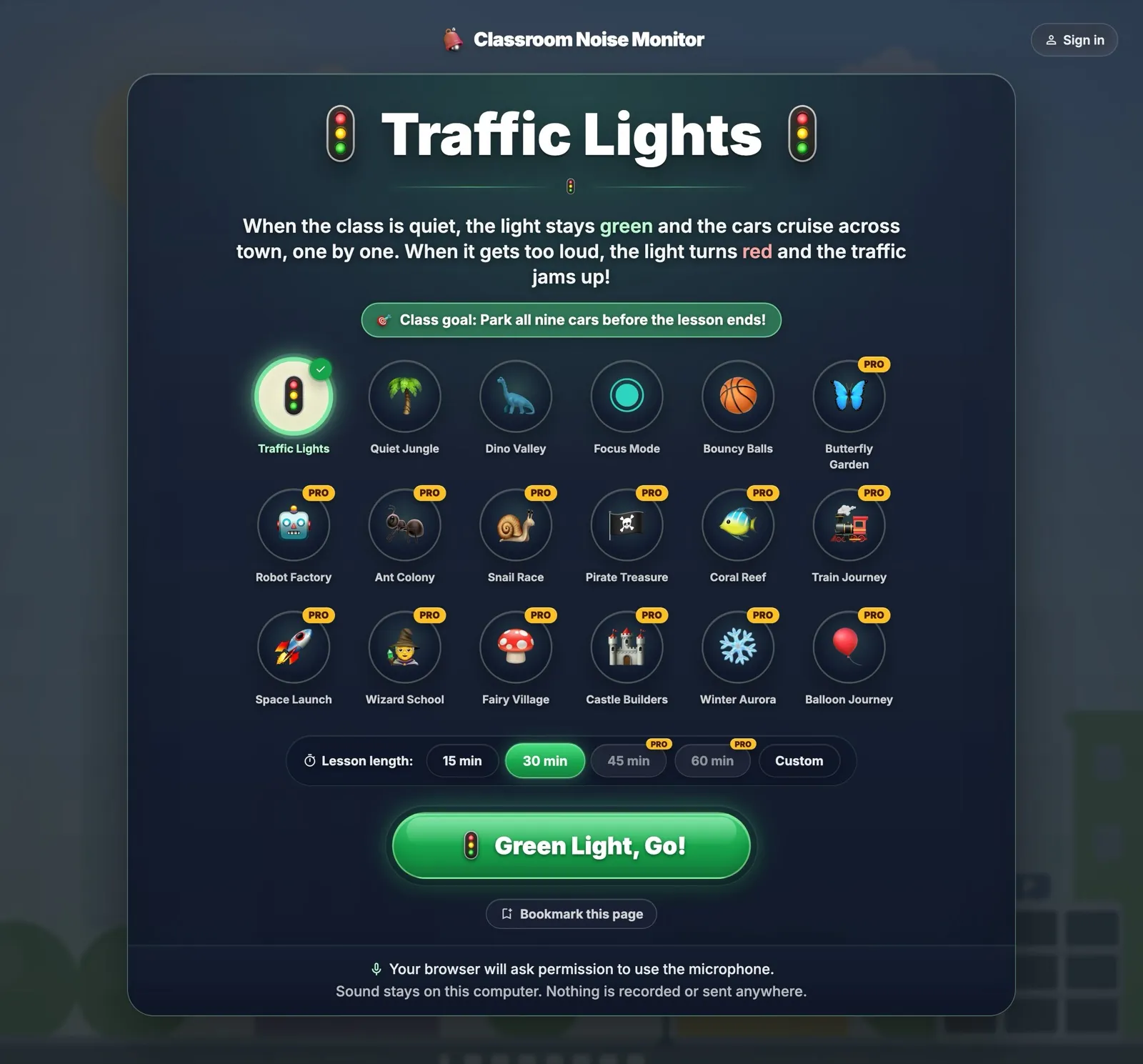
I built it after learning the hard way that a meter which only displays noise doesn't change much. My first projected meter was Bouncy Balls, which my class adored for two days and then turned into a competition to make the balls hit the ceiling. Display without stakes becomes a toy. What worked was giving the class something to protect: in my tool, the scene grows while quiet holds, eggs hatch, trees grow, and there are nine milestones to reach across a lesson. When the room gets loud, the scene visibly suffers. The screen becomes the referee, the class becomes a team, and I stop being the villain. The day I watched a student negotiate a whisper agreement with his neighbor to save milestone eight was the day I knew the shushing era was over.
Whatever meter you use, including mine, the craft matters more than the software. Set the norms before you ever project it, or it will become a carnival game (mine did, more on that below). Put the mic in the middle of the room, roughly student height, away from the AC unit, or it will lie to you. Recalibrate when you change rooms, because every room has a different baseline. And run it for specific activities rather than all day, because a meter that's always on becomes furniture.
A meter is not the only way to make noise visible. Hand signals work. Traffic light cards work. A rotating student "sound engineer" job works, and doubles as a lesson in listening. The advantage of a meter is that it never forgets to do its job, never plays favorites, and never needs its voice back. If you want to compare the options, I tested six of them with my own class and wrote up the results, including where mine falls short.
Layer 4: respond and reset without escalating
Even with the first three layers running, rooms drift. The skill is responding at the lowest possible volume, in both senses.
For attention getters, consistency beats novelty, and it isn't close. I keep exactly one clap-echo pattern for my younger groups and a raised hand with a silent countdown for older ones. Edutopia's famous list has 30 techniques and it's a fun read, but ten cute signals used randomly lose to one boring signal used every single time. The signal's power is its predictability. Change it and you're retraining the room from zero.
Below the whole-class signal sits the non-verbal ladder. Climb it from the bottom, and only step up a rung when you have to:
- Proximity: move toward the noise
- Eye contact
- The look
- A quiet, private word at the desk
- A public callout, the top rung, not the first
That last rung costs the student face and costs you the relationship, and both are expensive.
When the whole room needs a reset, reset the room, don't punish it. A few that interrupt the ratchet without threatening anyone:
- Thirty seconds of silence with a visible timer
- Lights dimmed for a minute
- A "stop and listen" moment where everyone finds the furthest sound they can hear
And know what escalation actually costs. Yelling works exactly once per novelty, and then you're just the loudest person in the room, modeling the very behavior you're trying to end, and spending a voice that, statistically, teachers cannot afford to spend.
What flopped for me (so you can skip it)
Every strategy article tells you what works. Nobody publishes their failures, so here are mine, with the mechanism of death for each.
Whisper-only days. Dead by 10 am. A rule that can't survive one wobbly moment isn't a rule, it's a countdown, and everyone in the room knows it.
The marble jar. My version, anyway. The reward was too far away; by Tuesday the jar was invisible to them. Delayed rewards need daily progress the class can see, which, in fairness, is the exact lesson I later built into my own tool's milestones.
Calming background music. In my room, music didn't calm the volume, it raised the floor the ratchet started from, because now everyone spoke over the music. I know teachers whose classes genuinely settle with quiet instrumental tracks, so try it, but watch whether it becomes a volume floor instead of a ceiling.
A noise meter with no norms. My own category of tool, and my own biggest flop. I projected a meter with zero setup, and the class treated it as a carnival game within minutes. The tool did exactly what I asked, which was nothing in particular. If a noise meter fails in your room, this is usually why, and it's fixable in one ten-minute norms conversation.
Shush-based management generally. See: my voice, the loss of. The data point is me.
None of these are universally bad, and your room may differ. But each failed in mine for a reason worth knowing before you spend a term finding out.
Adjusting for your students
By age group
K-2: visuals do the work. The levels scale needs pictures, not numbers, and meters with characters and stories land hardest, because a wilting tree is a moral emergency to a six-year-old.
Upper primary is where co-created norms peak. This age group will enforce an agreement with the zeal of small constitutional lawyers, and class-versus-the-meter becomes a genuine team sport.
Middle and high school: drop the cutesy stuff entirely. Expectations written on the board, calm consistency, and if you use a meter at all, a minimal display without dinosaurs. Older students respond to being treated like adults offered a clear deal: here's the working volume, here's why, hold it and I stay out of your way.
Sensory needs and neurodivergent students
Here's what the discipline framing of noise misses: for some students, noise isn't a rule they're breaking, it's a barrier they're behind. Research consistently finds that English language learners, students with mild hearing loss, and students with learning challenges report being significantly more affected by classroom noise than their peers. And hearing loss is more common than most of us assume: at any given time, 10 to 30% of students are working through mild or moderate hearing reduction from ear infections and similar causes. Some of your loudest students are the ones the noise is hurting most.
Practical adjustments that cost little:
- A quiet corner that's a resource, not a consequence
- Ear defenders available to anyone without ceremony, so using them carries no stigma
- A warning before predictably loud activities
- Noise expectations that are consistent rather than mood-based, because a rule that changes with the teacher's patience is impossible for many neurodivergent students to navigate
This is one quiet advantage of a visible meter: it makes the noise rule impersonal and predictable, which many students prefer to reading a teacher's face.
When noise is the point
A confession from a person who runs a noise management website: I don't want a silent classroom. Debate is loud. Drama is loud. Real group problem-solving sounds like a busy kitchen, and that sound is learning happening out loud. A classroom that's silent all day isn't well managed, it's underused.
The goal of everything in this article is control of the dial, not permanent zero. It's why my levels scale goes up to presentation voice instead of stopping at whisper.
The win isn't a quiet room. It's a room that can go quiet, and loud, on purpose.
Frequently asked questions
How do I quiet a noisy classroom without yelling? Work the layers: prevent unnecessary noise through seating, task clarity, and scripted transitions; set a posted noise-levels scale; make volume visible with a meter or signals; and respond through the non-verbal ladder before anything public. Yelling is the system failing, not the system.
What are noise level expectations in a classroom? The version that works for me is a four-level scale co-created with students: 0 silent, 1 whisper, 2 partner voice, 3 presentation voice, with every activity mapped to a level. For the technical answer, the US acoustics standard targets background noise under 35 dBA, which almost no working classroom meets.
What is the best attention getter for a noisy class? Whichever one you use every time. Consistency beats novelty: one signal, identical delivery, response required from everyone before anything continues. Rotating through clever signals retrains the class to wait and see whether this one counts.
Do classroom noise monitors actually help? They help with the one thing students can't do themselves, which is perceive their own volume, and there's evidence that background noise measurably costs learning. But a meter with no norms becomes a toy; mine did. Set expectations first. I compared six meters with my own class here, my own among them, flaws included.
How loud should a classroom be? The standard says under 35 dBA background, about a library whisper, while normal speech is around 60 dB. In practice, the dB number matters less than the contrast: pick a working level your class can hold for the activity, and protect the gap between working volume and focus volume.
Where this leaves you
The system, in one paragraph: prevent the noise that's really logistics, define what quiet means per activity with your students, make volume visible so the room can regulate itself, and respond low on the ladder when it drifts. Stop spending your voice; the statistics say you can't afford it, and honestly, neither can your Thursday afternoons.
My room is not silent. It's adjustable, which was the actual goal all along. If the layer you're missing is the visible one, the meter I built is free to try, no signup, right on the homepage. Bring your loudest class and start with the norms conversation first. I learned that one so you don't have to.